Rafael’s war code
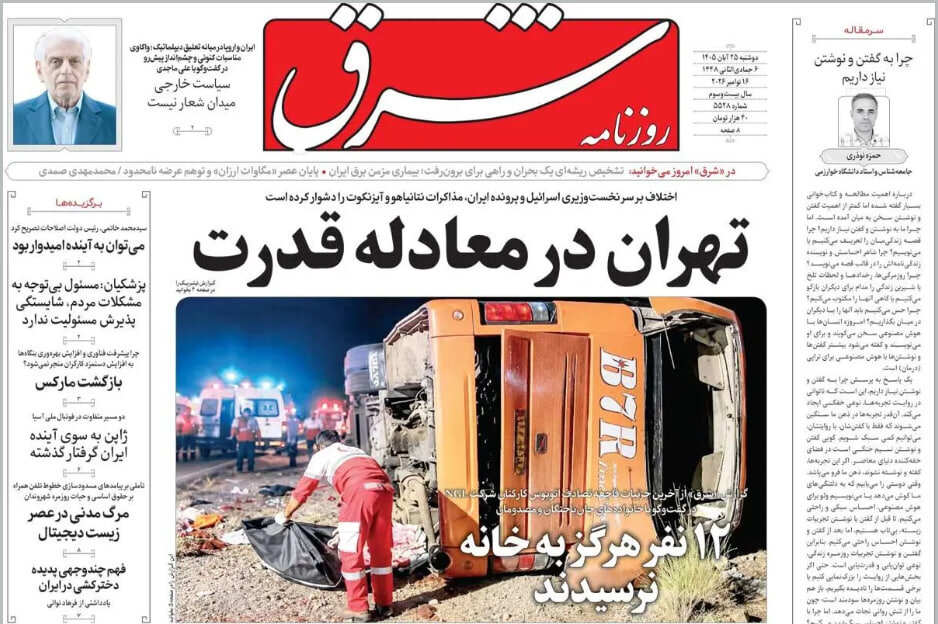
Shargh examined the 13-page report submitted by Rafael Grossi, Director General of the International Atomic Energy Agency (IAEA), to both the IAEA Board of Governors and the United Nations Security Council. The document reflects broader political and security considerations that could influence future international actions toward Tehran.
In the current environment, marked by both diplomatic negotiations and security tensions, any claim regarding limitations in verification could be used to justify increased international pressure. Shargh maintained that Washington continues to seek concessions extending beyond previous nuclear arrangements and may use such reports to support its demands. The newspaper therefore portrayed the report as a sensitive political document that could affect future diplomatic and security calculations involving Iran.
Etemad: National victory
In an interview with reformist political activist Ali Bagheri, Etemad discussed changes in US policy and political discourse toward Iran. Trump, who had previously presented himself as a firm supporter of Israeli positions, has been compelled to modify his rhetoric and behavior. According to him, recent political developments in the US have contributed to the reopening of communication channels and renewed prospects for dialogue with Tehran. The US government, which once rejected diplomacy in favor of pressure-oriented policies, now finds itself turning once again to negotiations and indirect contacts through third-party mediators. Bagheri characterized this shift as evidence that Iran’s approach has produced results. He described the situation as a “national victory,” arguing that it should be recognized by all political groups in the country. In his view, supporters of the resistance strategy and even those who previously questioned it should acknowledge the political significance of the renewed diplomatic atmosphere and the willingness of Washington to engage through dialogue.
Resalat: Trump and Hegseth share responsibility
Resalat focused on the relationship between Trump and his war minister Pete Hegseth, arguing that their political positions and responsibilities cannot be separated, particularly regarding policies toward Iran. Hegseth implemented strategies that had been approved and supported by Trump. As a result, the president cannot distance himself from decisions or outcomes associated with those policies. Resalat maintained that both figures are tied to the same political approach and must share responsibility for its consequences. The article also argued that assertions of success against Iran are largely political narratives designed to obscure deeper strategic problems. It said that criticism within the US increasingly reflects concerns about economic costs, geopolitical consequences, and reputational damage linked to these policies. The paper concluded that Hegseth functioned as a direct executor of Trump’s agenda and therefore any assessment of those policies must take into account the role of both individuals rather than treating them separately.
Jam-e-Jam: Enriched uranium and deterrence
Jam-e-Jam devoted its analysis to Iran’s insistence that its enriched uranium stockpile remain inside the country. The newspaper noted that Iranian officials have repeatedly emphasized that no enriched uranium will be transferred abroad. It argued that the issue is directly connected to national security because the existence of enriched uranium contributes to Iran’s deterrence capability and strengthens its strategic position. According to the analysis, the US seeks to limit the growth of Iran’s deterrent capacity through restrictions on nuclear activities. The paper maintained that removing enriched uranium from the country would weaken Iran’s leverage and potentially expose it to greater external pressure. It therefore described the material as an important element of defensive strategy. Jam-e-Jam further argued that preserving these resources provides future options for policymakers and protects national interests. For that reason, the newspaper concluded that maintaining enriched uranium within Iran remains a central strategic principle that should not be compromised in any future negotiations.
Arman-e-Emrooz: Public unity as a response to pressure
Arman-e-Emrooz commented on remarks attributed to US Treasury Secretary Scott Bessent concerning Iran’s economic and energy challenges. According to the paper, references to a difficult winter for Iranians were intended to increase public dissatisfaction and exploit existing economic concerns. The newspaper argued that US policymakers believe pressures related to electricity and gas supplies could be used to encourage social unrest and increase leverage against Tehran. In response, Arman-e-Emrooz stressed the importance of national solidarity and public cooperation. The paper argued that unity among citizens can serve as a powerful political response to outside pressure by demonstrating resilience despite economic difficulties. Drawing on recent periods of conflict and crisis, it maintained that Iranian society has repeatedly shown an ability to remain cohesive when confronted with external challenges. The article concluded that public solidarity not only reduces the effectiveness of pressure campaigns but also strengthens the country’s ability to navigate difficult circumstances. For this reason, the newspaper described social cohesion as one of Iran’s most important assets in responding to foreign pressure and preserving national stability.
Leave a Comment